
Design Strategy: Balancing User Needs & Business Wants

What is design strategy, and how does it fit in with the business?
The two work together in a delicate balance.
The business strategy can be a designer’s most important guiding artifact. It’s the easiest way to determine what the business wants to happen and should guide your work. But I bet you think about your company’s PowerPoint template more than you think about the business strategy.
When done right, they strengthen each other. A good business strategy is the starting point for a good design strategy, which helps bring a user perspective to the business.
So, design strategy, when done right, is a delicate balance of user needs and business wants. Like a spinning top, the stability can be surprising if you’ve never seen it done properly.

Let’s look closer at Design Strategy so that you can start to differentiate it from business strategy in your mind.
What is design strategy?
Design strategy is such a big field that it can be hard to narrow its scope to a single definition, but this is the best way I know to set boundaries around the field.
Design strategy is the overlap between user needs and business strategy. A design strategy helps focus on the user's needs, strengthening the business strategy.
I like to illustrate it with this slide in my work teaching design strategy:
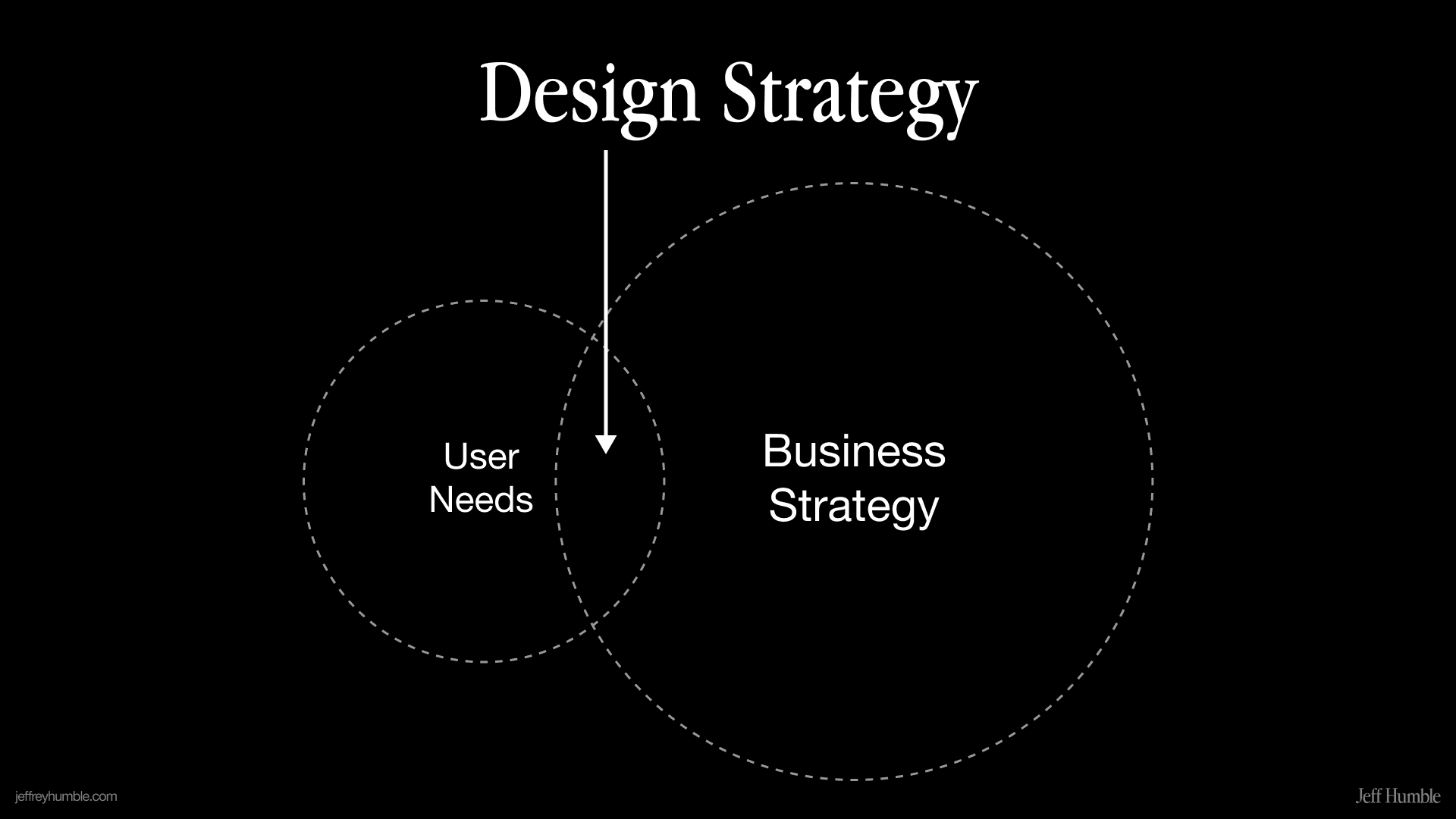
As you can see, understanding the business strategy is a key step in creating a design strategy. Even if there is no official business strategy at your company, it’s a good idea to start a design strategy by figuring out what the unofficial business strategy is, even if it’s locked inside an executive’s head.
Design strategy can be defined in other ways, but I like this definition because it highlights the uniqueness of a strategy based on user needs. Very few strategies are user-focused, and the design’s focus on users brings a much-needed viewpoint to strategy work.
Of course, some design strategies will focus more on the internal design team’s organization, budgets, or other aspects of design team management. It’s okay if it’s not 100% focused on user needs, but the highest calling of a design strategy is to focus on external aspects like user needs. If your design strategy isn’t visible to the user somehow, you’re probably not thinking big enough.
I talk a lot about design, UX, and product strategy, but all these strategies differ from the business strategy. You want to start your design strategy project by understanding and aligning with the business strategy.
Example of Design Strategy at Apple
Let’s say you are a design strategist working at Apple in the early 2000s.
Apple’s business strategy was focused on vertically integrating its hardware, software, and services into a seamless customer experience where everything works perfectly.
If that sounds too easy, remember that in the early 2000s, most hardware devices didn’t work well together. You had to have a different device for every task, and none of those devices could talk to each other. Apple’s business strategy is a smart way to stand out and build a defendable position in the market. So, what is the design strategy?
Let’s focus on the word “seamless.” What user needs might seamlessness across devices provide?
- Possible user need #1: Seamlessness might solve the user’s need to switch between devices quickly throughout a work day. i.e., moving from work to home computers
- Possible user need #2: Seamlessness might solve the need to integrate more devices into your workflow that otherwise might not work together. i.e., using your digital camera while you’re at your desk
- Possible user need #3: Seamlessness might fill the need to live in the future and attract people for the sheer experience of having a device that feels magic. i.e., when you drag a file into a program and it automatically does the thing you want
- Possible user need #4: Things that work out of the box might be critical for older users who don’t know how to customize their tech and need smart defaults. i.e., the laptop is charged and ready for use immediately after only 5 short questions
- Possible user need #5: Customers that run into issues might want a repair service that is integrated with the ecosystem and conveniently located for their daily life. i.e., the Apple Genius bar at the Apple Store
Of course, you would want to do a lot of research to answer these questions and find unique user needs that are lucrative for the business. Design can help Apple integrate their strategy in the Apple ecosystem in many ways.
Here are a few things that could be part of a design strategy of Apple in the 2000s
- Design strategy principle: Universal interactions with any screen, whether a phone, computer, or TV…aiming to unify voice and touch interactions on all Apple devices.
- Design strategy principle: Futuristic and minimal design language that blends hardware and software…aiming to make the hardware and software so integrated you can hardly tell where hardware ends, and the software begins.
- Design strategy principle: A user experience so clean and smooth that it works intuitively… aiming to make the experience so simple that even elderly users can use it without instructions.
It’s pretty amazing how you can provide so much guidance with only three principles, right?
Of course, the design strategy could have had many more aspects, but maybe you can see how these three design principles could form a solid design strategy. These three principles alone could still help guide design at Apple today.
That’s the power of strategy: it moves you toward your vision with high-level direction that can last decades. And if done right, you don’t need to change your design strategy until the business strategy changes. Next, let’s dive deeper into business strategy since it’s so important.
What is business strategy?
Now that we have a handle on design strategy, let’s look at the larger business strategy domain. The business strategy at your company is essential to knowing if you’re moving in the right direction.
Business strategy is the strategic initiatives a company pursues to create value for the organization and its stakeholders and gain a competitive advantage in the market*. This strategy is crucial to a company’s success and is needed before any goods or services are produced or delivered.*
-Harvard Business School
Business strategy is all about competitive advantage in the market, which means creating value for customers in a way nobody else can.
(more on business strategy here)
Align to the business strategy; you should always be on the right decision-making side.
But sometimes, it can feel like the business strategy is too big to be useful for your team. That’s a good indication that you need a functional strategy.
The 3 Levels of Strategy
Did you know that there are three possible levels of strategy?
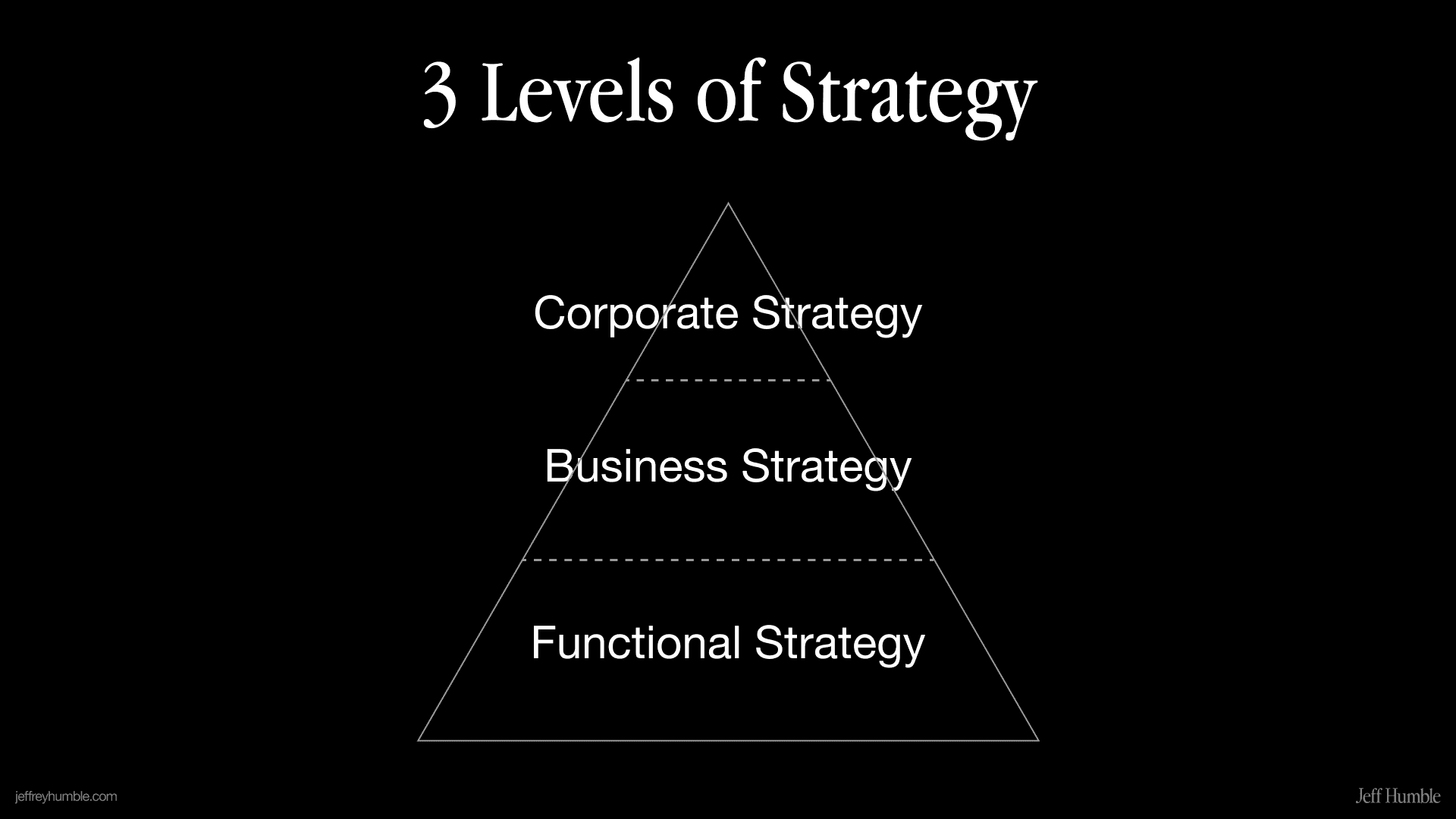
- Corporate Strategy: Corporate strategy guides multiple businesses, but not every organization needs one. Corporate strategies deal with things like diversification, mergers/acquisitions, and resource allocation for a portfolio of businesses. For example, Alphabet owns many companies, such as Google or YouTube, and they all share a corporate strategy, likely something about owning user-generated content through high-quality cloud-based tools supported by ad revenue. The corporate strategy guides all of the businesses in a corporate portfolio. For many companies, this layer doesn’t exist.
- Business Strategy: One level below corporate strategy, we have business strategy, the most talked about level of strategy. The business strategy is all about the company’s unique value proposition and focuses on finding that special competitive edge in the market. Why be the best when you can be the most unique? Business strategy concerns positioning, user persona, competition, pricing, marketing, and operations. For example, Google’s business strategy is to dominate search by filtering the internet with proprietary algorithms that entice people to use services that deliver ads or collect data to improve targeting. YouTube has a similar but specific strategy that applies this approach to user-generated video.
- Functional Strategy: At the bottom of the pyramid lies the team-specific strategies. These are function or department-specific strategies that translate and align with the business strategy. This is where you will find the UX, product, brand, and marketing strategies. For example, YouTube’s product YouTube Premium probably has its own product strategy, as it follows a paid subscription model which is slightly different than the ad-supported model of YouTube in general. Here, the functional strategy is needed because the business strategy alone won’t be enough to guide the team. Not every team will have a functional strategy.
UX, design, product, brand, and growth strategies are all functional strategies. They are specific interpretations of the business strategy that a specific team interprets.
Finding that Overlap of User Needs and Business Wants, a.k.a. Your Design Strategy
Ok, so you’re sold on the need for a design strategy. What does that process look like?
It will take a lot of research and co-creation to get to a high-quality design strategy.
I teach a course on the process, and I can tell you it’s not easy. Designing a strategy will be one of the toughest projects of your career. I created a canvas to help guide my students through the process, but it’s still a tough undertaking.
The good news is that getting sharper on user needs and your company’s business strategy will always be good for you. The insights from a design strategy project are worth their weight in gold.
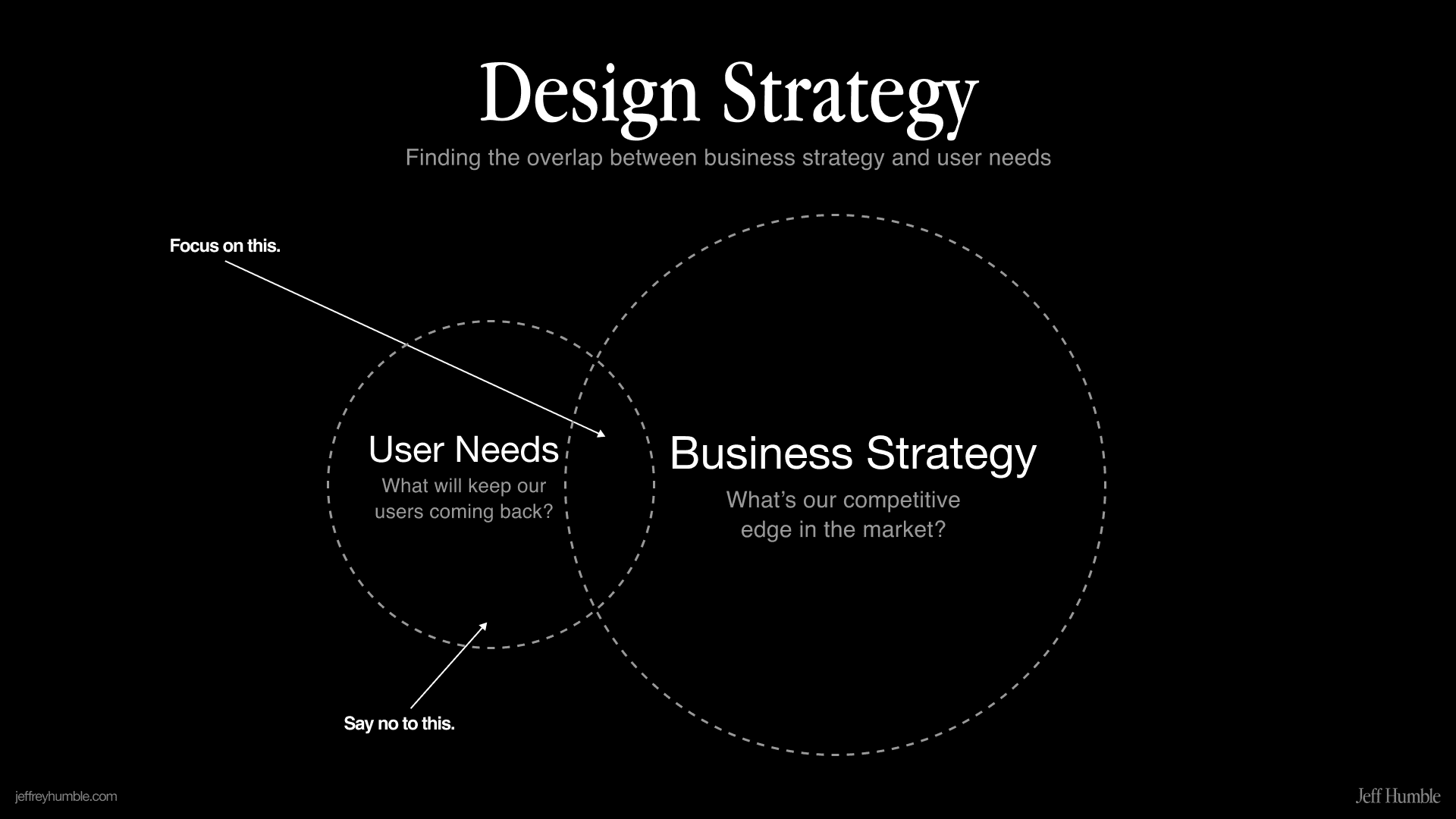
A crucial role of design is staying in touch with user needs and expectations. If you do that, you’ll probably hear things from users that don’t align with the business strategy. Part of your job in creating a design strategy is to identify things that do and don’t align with the business strategy related to design.
AirBNB Example of Design Strategy
Let’s say your company’s business strategy is a two-sided marketplace, like Airbnb, between homeowners and tourists. Everything you do should strengthen that interplay between homeowner users and tourist users. Sounds simple, right?
What if users tell you they need their favorite host and message them outside of the app on WhatsApp? Should you listen to that user’s need? No. Unfortunately, you cannot grant that user request.
There are some user desires you can’t grant because they contradict your business strategy.
You must say no to user needs that align with the business strategy and yes to those that strengthen it. Understanding when to do that is the first step toward a design strategy.
It’s the overlap that is your design strategy.
It helps you say no to the things that won’t improve on the business’s strengths.
The power of design strategy
Design is, in the end, about people. That’s the power of design, and it’s also the power of design strategy.
Business strategy often takes an internal view that neglects the human element. Executive may think that their strategy is brilliant, but business strategy is only an assumption until it comes into contact with the market.
Design strategy helps de-risk business strategy. It strengthens the business, by finding specific user needs, wants, and desires that align with what the business is trying to do.
Neglecting the human side of a strategy is always a risky endeavor.
A design strategy helps you align the business strategy (a.k.a., the business wants) with the human side (a.k.a., the user needs).
Learn how to create a design strategy with Jeff
Want to create a design strategy for your company?
Join me for a six-week design strategy program with LIVE classes, feedback, and all the resources you need to master design strategy.