
The 4 D’s of Good Strategy Design

One of the hardest things about strategy is knowing how to judge if it’s good or not.
Good strategies are rare. It’s a sentence you will hear often from strategists. In my experience, around 90% of strategies are mediocre.
So, how can you tell if your strategy is one of the good ones? Use the 4 D’s of Strategy Design to evaluate your strategy and take it from mediocre to great.
Why strategy is difficult to evaluate
Strategy projects will be among the toughest projects of your career. There are many reasons why strategy work is more difficult than regular project work.
-
Strategy is always an educated guess.
Strategies offer a way to deal with the future and uncertainty, but to do so, they must be educated guesses and theories based on research. You will never know if your strategy will work, which can be nerve-wracking. Evaluating a strategy can make this uncertainty feel less risky.
-
Strategy designers are biased.
The strategist designs the strategy, but someone else uses it, making it difficult to evaluate. If you’re creating a strategy, you’re often so close to the project that it’s hard to know if you’re too in love with your ideas. Your biases might make a mediocre strategy seem good to you. You’ll need a way to evaluate your strategy objectively.
-
Strategy experience is challenging to come by.
If you’re not a strategy consultant or a CEO, it’s rare to get the chance to design a strategy, so you won’t have much of an instinct for what’s good. Many in-house strategists only get the chance to work on a few strategies in their entire career. You’ll want some evaluation tools to be able to judge a strategy.
For all these reasons, you’re going to want as much help as you can get.
The Difference Between Internal and External Strategies
Before we begin, you need to know that there are two major strategy types: internal and external.
Internal strategies aren’t meant for the public but help companies gain an edge by reshaping how things work behind the scenes. These strategies often (but not always) look back at what’s been accomplished to improve profit margins. They often involve areas like operations, optimization, and reorganization.
External strategies are meant to be public and help a company gain an edge in its market positioning. These strategies often (but not always) look forward to new opportunities to capture new markets. They often involve external aspects of the business, such as brand, marketing, design, and product.
Understanding whether your strategy is internal or external is crucial because it changes your evaluation.
Got it? Let’s examine the 4 Ds so that we can peek under the hood, and get our strategy engine running smoother.
The 4 D’s of Good Strategy Design
There are hundreds of books on improving strategy, but very few will tell you if the strategy you design is any good. So, here’s a framework I developed to transform a mediocre strategy into a great one.It consists of four questions that will challenge you to improve your thinking.
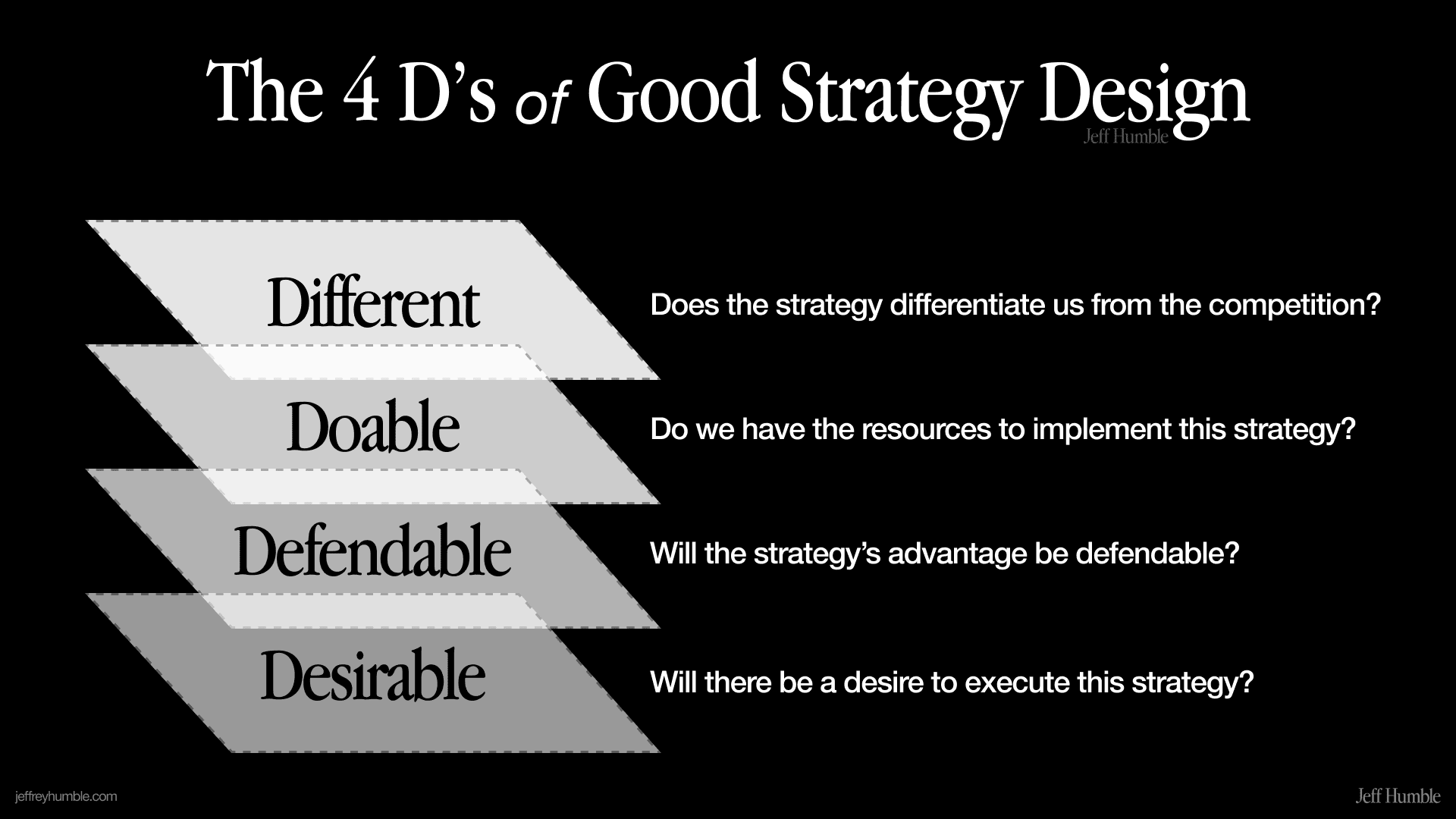
by Jeff Humble
-
Different: Is the strategy different from the competition?
Strategy should be about doing things differently than the competition.
You won’t benefit from the power of strategy if your strategy is generic or too similar to the competition. A strategy helps you avoid competing entirely by carving out a piece of the market that you can own and grow. Even if you take inspiration from another company in a different industry, try to be the only company in your market doing so.
Nokia used to be the most famous phone maker in the world, and their cheap, durable phones were the best in the market. However, when Apple initially succeeded with expensive, breakable phones, Nokia started making phones like Apple. Their strategy to be “better than Apple at being Apple” was doomed to fail. Ultimately, they lost almost all of their market share to Apple. Some of the world’s most famous companies have lost billions by developing strategies that aren’t different enough from their competitors.
Examples:
An internal strategy built around a generic approach like Agile is not differentiated.
An external strategy built around copying Apple’s design language is not differentiated.
-
Doable: Do we have the resources to pull off this strategy?
You should try to align your strategy with the organization’s capabilities.
Don’t get carried away with desirability to the extent that you can’t execute the strategy. You want a strategy that fits your company’s skills and setup. Strategy consultants often make the mistake of pushing for a strategy that doesn’t fit the culture and talent in the organization, so make sure your strategy is feasible and aligns with the company’s culture.
Southwest Airlines ’ low-cost flight strategy is an excellent example of a doable strategy. Southwest’s initial strategy was to compete with buses rather than other airlines. They could have stopped with that aspiration, but they didn’t. They made the strategy doable by designating what they would and wouldn’t do. They decided they had to cut a lot if they wanted to make their flights low-cost and competitive with buses. They cut in-flight meals, lounges, and flight options to make their strategy doable. Sometimes, your strategy is only doable by deciding what you won’t do. A doable strategy ensures your strategy doesn’t become a lofty aspiration that employees ignore.
Examples:
An internal strategy built around custom AI tools when you can’t afford the engineers is not very doable.
An external strategy built around sustainability from a big polluter in the mining industry is not very doable.
-
Defendable: Will the strategy’s advantage be defendable?
A strategy should be difficult for competitors to copy.
Since strategy is all about differentiating, you want to ensure that you stay differentiated. Your strategy should give you a lasting, sustainable advantage over your competitors, not just a brief boost that can be easily copied. This D is last because it’s the hardest. Finding ways to generate lasting advantages is very difficult, and for many companies, defending your strategy might be a continuous battle. You can improve your defendability with anything from patents to re-brands to custom infrastructure.
Apple’s strategy for a seamless user experience on any device is defended by its investment in the Genius Bar and thousands of Apple retail stores. This free service for Apple customers helps fix any problems in the user experience so that even people who aren’t tech-savvy can buy an iPhone or a Mac without fear of technical problems. The software platforms also provide dependability as the software and hardware is controlled by Apple, which helps improve the user experience’s seamlessness. Competitors like Android can’t even begin to compete because they don’t have the stores, the repair area, or the total control over the operating system between hardware and software. A defendable strategy provides a lasting advantage and can’t be copied easily.
Examples:
An internal strategy built around a widely-available tool like ChatGPT isn’t defendable.
An external strategy built around a design trend isn’t defendable.
-
Desirable: Will there be a desire to execute this strategy?
What story are you telling about your strategy? When people want the strategy, execution is easier for everyone.
Your strategies might make sense, but that doesn’t mean people will be excited to implement them. Execution is probably the most challenging part of a strategy project, so ensure you have something people are eager to implement. Desirability might mean aligning with larger consumer trends, embracing innovative working methods, or adapting the strategy to the region’s consumer preferences. A lack of desirability might mean slow adoption, internal pushback, and negative feedback. Seek feedback early and often to ensure you have a desirable strategy.
Starbucks is an excellent example of a desirable strategy. Their initial strategy was to create “third places” in the United States where people could congregate and think outside work and home. Consumers loved this strategy because it fulfilled a real need for public spaces in the U.S. Companies get free press and momentum when they create a desirable strategy.
Obviously, you won’t talk about the strategy the same way inside the company vs. outside the company with customer. While most companies are used to crafting an external PR story from a strategy, most don’t realize that the same thing has to be done before a strategy is ready for internal implementation. Sometimes, you have to translate your strategy into something more desirable for internal stakeholders. The desirable layer is a check that you have spent the time to translate your strategy’s story into a desirable future for everyone involved. And if you can’t find a positive side, maybe you should reconsider your strategy.
Examples:
An internal strategy for a U.S. automaker to move manufacturing to China was not desirable to U.S. employees, so they were hesitant to implement it.
An external strategy for a delivery app that emphasizes the laziness of customers ordering food to their homes will not be desirable to consumers and will cause the strategy to fail.
You can use the 4 Ds to evaluate your strategy and transform a mediocre one into a lasting one. It won’t be easy, but strategies are costly projects. Wouldn’t you want all the help you can get to ensure it’s a lasting strategy?
Hire Jeff to get a 4D strategy.
Are you unsure how to get your strategy to satisfy the 4 Ds? That’s what I do.
Let me help turn your existing strategy into a winning strategy.
Got another aspect of strategy that’s crucial?
Let me know in the comments…even if it doesn’t start with a D.