
The Secret Killer of Strategy Projects

What is the secret killer of strategy projects? The answer may surprise you.
Strategy projects can encounter a million difficulties, but one thing threatens them more often than anything else. And the sooner you prepare for it, the better.
If you’re new, you will almost certainly fall prey to this threat, especially if you try to do the work alone.
What is the threat? It’s the chance that your finished strategy will be completely ignored. It’s you sharing your shiny new strategy, but all you hear are crickets. 🦗🦗🦗
Why strategy projects fail
We often start strategy projects with too much optimism.
Strategy projects are challenging.
After bumbling around for a few months trying to figure out how to align your work with all the existing visions, OKRs, and strategic plans, you might regret taking on a strategy project.
To complicate matters, the whole team should adopt your plan, which is challenging even for a small strategy.
Your strategy will likely be ignored if you don’t have the buy-in and authority needed. Strategy projects are truly high-risk projects.
For example, a UX strategy is easily ignored if not done well. A UX strategy aligns with the business strategy and guides the UX team. Low-level strategies like UX strategies (known as functional strategies) that stem from the business strategy are always at high risk of being ignored.
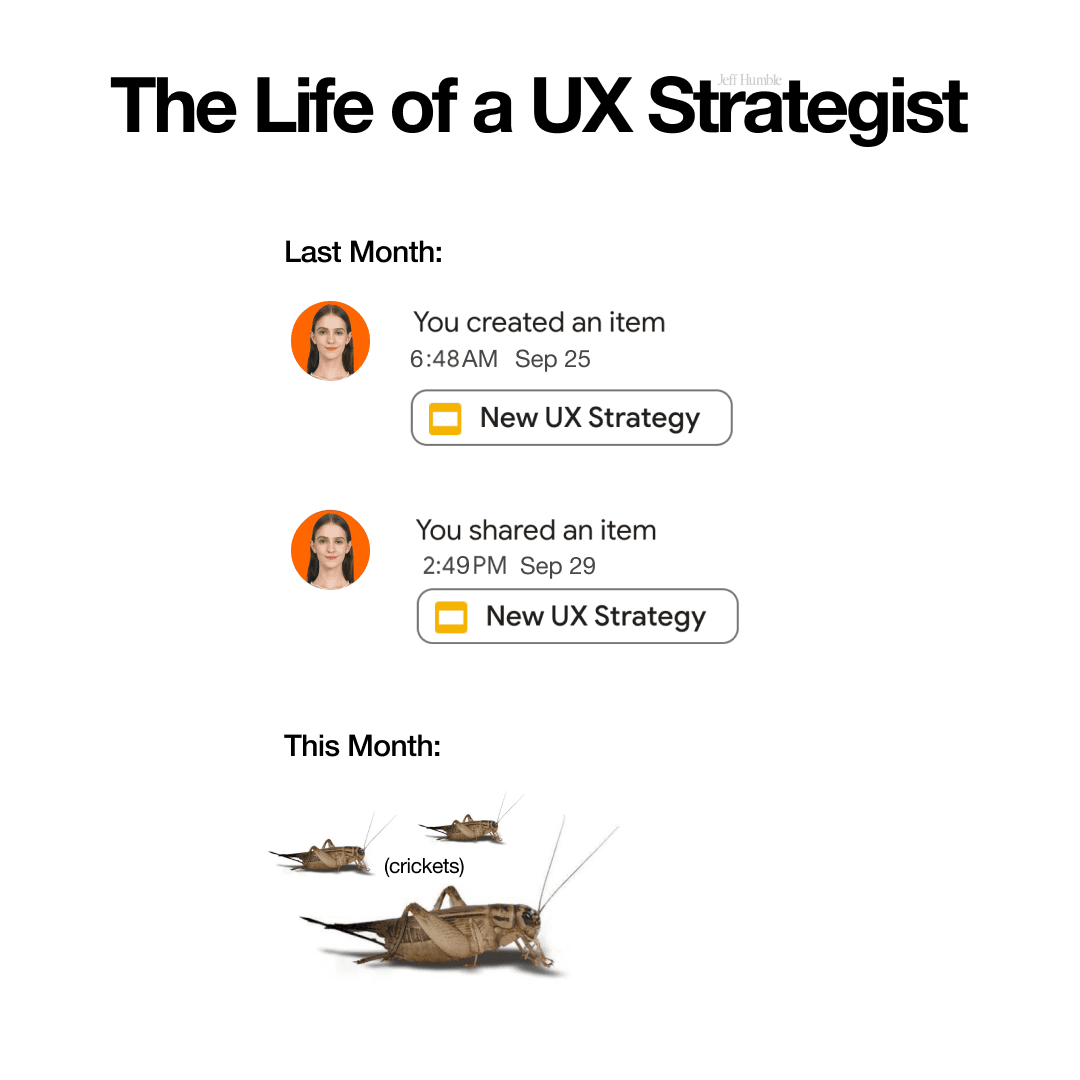
The biggest hurdle in strategic projects is the last hurdle…the one where people either adopt your ideas or ignore them.
Being ignored is a far worse fate for a strategic project than a poorly designed deliverable. At least if you were wrong and get feedback, you can correct your course.
No, it’s far worse to be ignored entirely.
After months of work, all you get is crickets 🦗🦗🦗.
Being ignored is even more painful when you have already sunk months of work into your strategy.
What an ignored strategy can mean
There is probably a lot going beneath the surface when people ignore your strategy deliverables.
Worst case scenario, their silence means they hate your strategy.

Best case scenario, they simply forgot about you and your strategy.

Whatever the reason, their silence can be deafening.
Why do people ghost your strategy? Well, maybe you should stop thinking of it as your strategy.
Put yourself in their perspective for a moment. How would you feel if you woke up to an email with detailed directions on how you were supposed to act for the next five years? That’s what strategy execution involves, so don’t take it lightly and work to build their trust. Execution is everything with strategy.
NOTE: you might not have this problem if you’re the CEO. High-level executives can define a strategy, and everybody has to execute it or get fired. CEOs can demand that the organization adopt their approach, but for everybody else, this article is for you.
Strategy projects aren’t like regular projects; you’re doomed to failure if you treat them like any old project. You have to re-think your project process when you’re designing a strategy.
How to avoid strategy project failure 🦗
So how do you prevent the crickets?
Bring people into the strategy process. They’re probably creeping on your work already. You might as well let them in.

First-time strategists often go off on their own, polishing their strategy for way too long without letting their team take a look. By the time they realize they’re polishing a turd 💩 rather than a diamond 💎, it’s too late.
Here are three tips to make sure you wind up with a diamond that nobody will ignore:
-
Build a coalition for your project.
Don’t do anything strategic in a vacuum.
If your team only sees the strategy when it’s done, you’re doing it all wrong. In strategy projects, there shouldn’t be a “handover.”
Try to involve your stakeholders and decision-makers in the strategy design process, even if it’s just a monthly collaborative working session. When people participate in a project, they’re usually more invested in the outcome. The more invested they are in the outcome, the more likely they are to buy in to the results.
-
Stay a few steps ahead of the team.
Even if you’re taking a collaborative approach, that doesn’t mean you have to go the same speed as your collaborators. If you want to lead the strategy project, your focus should be designing the project plan, which means you’ll need to be ahead of the group.
The best way to do this is to do your homework before collaborating. You’ll need to do some research on your own time before each team working session. That way, you can compare your insights with the team’s insights.
Don’t be afraid to get your hands dirty as you get out ahead of the process. Of course, it helps to know what the project process looks like. Use my Strategy Canvas if this is your first strategy project.
-
Frame the problem together.
One of the biggest reasons people ignore your strategy is that the stakeholders don’t really “feel” the problem the strategy attempts to solve. You have to feel the pain before you will be invested in a solution.
For example, your colleagues may not realize that churn is your company’s biggest problem. Executing a strategy to overcome churn before the team agrees that churn is the right challenge won’t help people get excited by your strategy. Once the team agrees on the diagnosis of churn, everything gets easier.
Just like in regular projects, agreeing on the problem is half the battle, so you should prioritize your strategy research before considering any sort of solution.
Once everyone involved agrees on the problem’s diagnosis, you can proceed to the treatment, a.k.a. your strategy deliverable.
Practice strategy with Jeff
Mastering the process behind strategy is the best way to ensure your strategy project works. However, that can be difficult because strategy projects don’t come often.
Your company might go five years before changing strategy, making every strategy project high-risk. How can you prepare?
I developed an online course to help aspiring strategy designers master the strategy process.
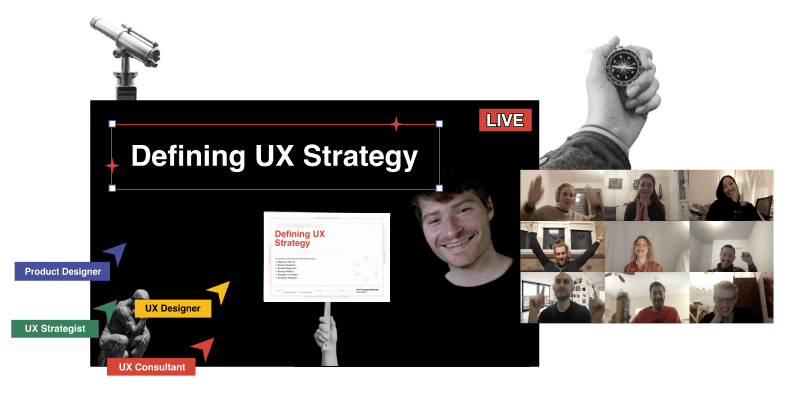
Together, we go through the process, and I provide feedback every step of the way.
It’s one of the best ways to gain experience designing strategies before you do it for real.
Learn more about the course here.
It pays to be prepared
Strategy is all about seizing the right opportunity at the right time. This means every strategy has a time window, so it pays to be prepared. Otherwise, you might miss your shot.
When a strategy is needed, it’s already too late to learn about the design process. Being prepared as an in-house strategist means you want to be the most experienced strategist on your team so that you can lead the project.
Strategy experience is rare, so even a bit of practice will be better than most. And once you get a full strategy project under your belt, you will have the project of a lifetime to share with future employers. Who doesn’t want to hire the person responsible for a winning strategy?
Experience is always the best teacher, but at least now you can be prepared for the biggest threat to strategy projects (🦗).