
The 4 Risks of Innovation and How to Test Them
We’ve all experienced the frustration of buying a shiny new product only to find it unusable when we get home.
Some of us have even owned a perfect product, but the company sadly goes out of business because it’s not profitable enough.
And we’ve all seen CEOs promise big things that never quite turn into a working product.
All these scenarios can happen when teams skip innovation risks.
What are they? Let’s dive into the risks that can make or break new products.
The 4 Big Risks of Innovation
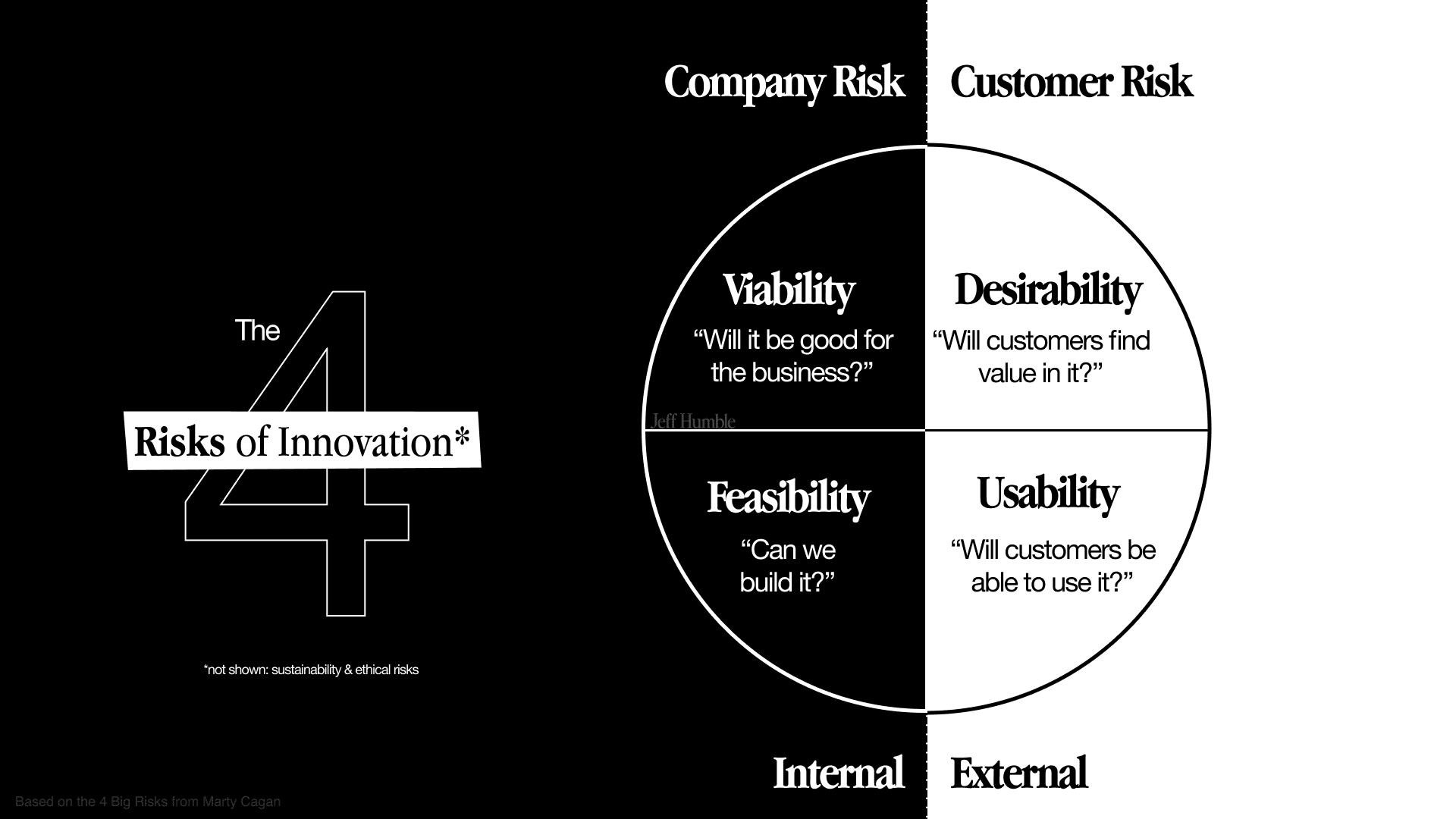
Let’s start with the whole picture. There are four risks we want to focus on.
[by Jeff Humble]
Of course, there are risks not pictured here, such as sustainability and ethics, but to get started, let’s just focus on these four.
Viability and feasibility are internal risks often tested through internal expertise, research, and analysis. Desirability and usability are external risks tested through prototyping, researching, and studying customer data.
Here’s a quick breakdown of each innovation risk:
- Viability Risks, a.k.a. “Should we build this?”
These risks are owned by business and marketing and validated by business stakeholders. They are validated through market research, competitive analysis, revenue modeling, and compliance checks. - Feasibility Risks, a.k.a. “Can we build this?”
These risks are owned by business and engineering and often validated by tech stakeholders. They are validated through resource assessments, architecture tests, cost-benefit analyses, and pilot programs. - Desirability Risks, a.k.a. “Will people find value in this?”
These risks are owned by product/design and validated by customers and users. They are validated by user interviews, prototype testing, social listening, and A/B testing. - Usability Risks, a.k.a. “Will people be able to use this?”
These risks are owned by product and design and validated by customers and users. Task-based testing, click-tracking, heatmaps, heuristic evaluations, and post-launch analytics validate them.
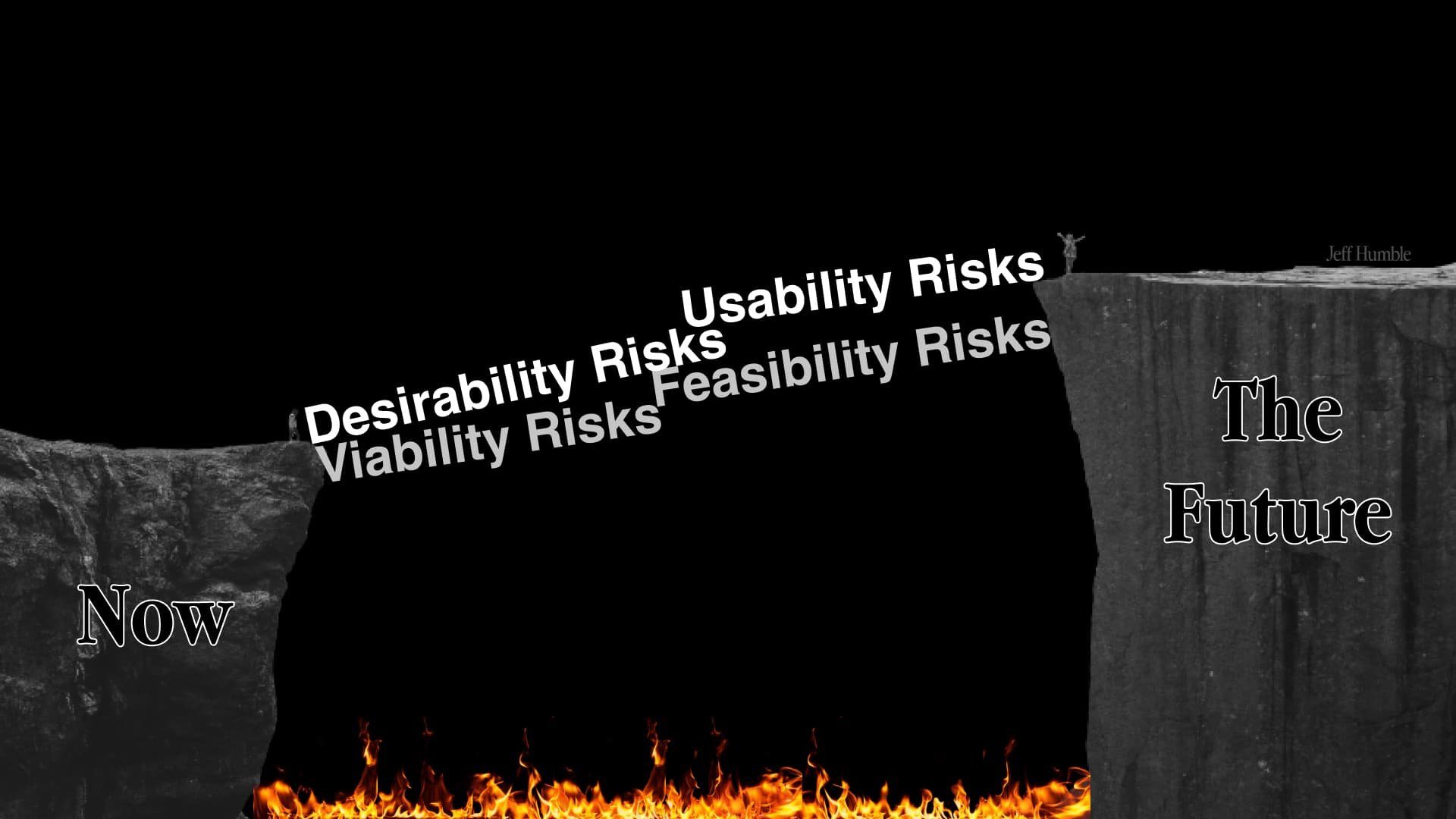
I like to think of these risks as pieces of a bridge that, once tested, lead to a stable future. Viability and feasibility form the first layer of company-driven stability, while desirability and usability form the second layer of customer-driven stability.
[by Jeff Humble]
Everyone, including executives and CEOs, should work through these four risks if they want their ideas to be successful.
Rather than trying to “prove your idea” (which is problematic because it begs confirmation bias), you want to put it through four different risk evaluations. If the concept makes it through the four types of tests intact, we can use words like “proof” and “validated.”
As you work through an innovation idea, you work through these risks.
The Cybertruck and the 4 Innovation Risks

[from Tesla’s website]
Tesla’s Cyber Truck is an excellent example of an innovative idea that had some difficulty getting through all four checkpoints. It’s also a highly controversial product, so hopefully,that will make this little case study more interesting.
Let’s break it down:
Viability, a.k.a. “Should we build the cyber truck?” (internal company risk)
Somebody inside Tesla looked at the truck market and saw an opportunity. Somebody probably considered the brand implications and thought it would strengthen the company’s other offerings. Somebody else probably looked at customer profiles and thought a DeLorean-style truck would align with a specific buyer profile. Perhaps somebody even said that it aligned and strengthened Tesla’s business strategy.
Or possibly, Elon Musk just said, “This is cool. We’re doing it.”
Viability can happen in various ways, but it’s usually handled by people higher up than the people who will eventually build the idea, such as the team leads or MBA types. What’s certain for the Cybertruck is that many spreadsheets were involved in determining the viability risk of this idea.
Feasibility, a.k.a. “Can we build a cybertruck?” (internal company risk)
One of Tesla’s biggest struggles is the buildability of its innovative, new ideas. The engineers at Tesla have to be either highly optimistic or naive or don’t get a choice because many companies wouldn’t let an idea like the Cyber Truck out of the concept department.
Somebody with a good understanding of what was possible said, “Yeah, we can build that thing.” After several years of delays, that person probably got fired.
Technical engineering teams usually handle feasibility, and they must truly understand an idea’s entailed risks before they can approve the risk involved.
Desirability, a.k.a. “Will people find value in a cybertruck?” (external customer risk)
The pre-sales for the Cyber Truck are a textbook example of a desirability check passed. This product not only generated a lot of buzz, but it generated the promise of a lot of money. They received 2 million pre-orders for the concept. “Just 15 percent of those preorders would equal the annual US truck sales of Toyota,” says Boston University Questrom School of Business professor Tim Simcoe.
The desirability check has most definitely been passed. Later, when customers have the full experience, the desirability test may not last, but millions of pre-orders is a good validation of the desirability.
Sometimes salespeople or customer service reps act like the desirability risk is low because “everyone has been asking for this thing.” Be careful about listening to anecdotes to pass the desirability check. You will want cold, hard data before you risk putting something in front of fickle customers who aren’t wowed by the idea.
Usability, a.k.a. “Will people be able to use the cyber truck?” (external customer risk)
At this point, most people who pre-ordered the truck haven’t used it. But does it matter? The die-hard fans will buy the Cybertruck purely based on status and demand. How important is the usability check?
The usability of the vehicle will determine if the product gains widespread acceptance. Once the product debuts, it will be the difference between good and bad reviews. It will either bring a smile or a frown to your face while using the truck.
Of course, videos can demonstrate the truck’s usability, but it’s hard to know if you like a car until you’re sitting in the driver’s seat. This overall feeling you get when something is usable is one of the reasons that usability is so hard to test before launch. For example, a retractable roof for the truck bed seems desirable, but will it be usable? Can I sit on the roof when it’s closed? Do I trust the roof to keep raccoons out (you shouldn’t)? Can I sleep back there? Until I use it, I’m not sure.
How to Test the 4 Risks of Innovation
Identifying the four risks isn’t enough. You’ll also have to de-risk them through a series of tests. If you’re like most people, you will first see your idea as perfect.
However, we can start dissecting and testing our ideas by using the four risks as lenses to identify future problems.
Let’s look at each risk and seven ways that we might test the risk.
How to Test for Viability?
Viability is about ensuring the product meets financial and market goals in the long term.
Here are some ways to test for viability risks:
- Revenue Modeling: use spreadsheets and pricing estimates to understand which combinations of offerings will appeal to users
- Competitive Analysis: examine relevant competitors and their positions in the marketplace to determine whether your idea is worth pursuing.
- Customer Interviews: interview your target user and uncover problems, pain points, and issues that will tell you whether your idea is solving a real problem
- Willingness-to-Pay Surveys: use a survey methodology like Van Westendorp Price Sensitivity Meter to determine an acceptable range of pricing based on user feedback
- Break-Even Analysis: figure out the bare minimum in revenue needed to cover the costs and make the idea profitable
- Channel Effectiveness Analysis: research acquisition costs to determine the marketing channels with the cheapest CAC (Customer Acquisition Cost) to make your idea more viable
- Jobs-to-be-Done Analysis: interview users to determine the “job” they hired you to do to establish the long-term viability of a problem and solution
How to Test for Feasibility?
Now, it’s time to look at how to test the technical buildability of the idea.
Here are some ways to test for feasibility:
- Capability Gap Assessment: evaluate the execution teams’ expertise to determine if it matches the requirements of the innovation project
- Functional MVP: build an early prototype to test the minimum required functions to establish the technologies needed to make the project a success
- Scalability Tests: create sample workloads to test the architecture of your planned tech stack, ensuring the finished idea can withstand the stress of daily challenges.
- Compatibility Tests: test your chosen tech stack against other tools and libraries that will be needed to implement the innovation idea
- Pilot Program: run a test of the entire experience with a small user group to see if you can handle the operations load of the innovation idea
- Interactive Prototype: build a clickable prototype to uncover any UX/UI bottlenecks early in the process
- Workflow Efficiency Analysis: create user flows to map out the potential bottlenecks in the steps that the user will take to accomplish core functions and try to simplify those steps
How to Test for Desirability?
Desirability is extremely important, especially if you don’t know your customer well. But don’t worry—there are many methods you can use to test desirability.
Here are some of the most popular ways to test for desirability risks:
- User Interviews: interview your target user and uncover needs, preferences, and desires that will tell you whether your idea will be desirable through deep user insights.
- User Surveys: like interviews, user surveys query your users, allowing you to ask the same questions to a larger group with shallower insights.
- Preference Testing: show multiple product versions and have users pick their favorite. This one can be an early concept version that can later be A/B tested.
- Prototype Review: share your early prototypes and gauge your users’ initial responses by ranking features as desirable. This can even be paired with a user interview.
- Landing Page Tests: design a page that outlines the core value you’re trying to test, and have users either sign up for a waitlist or interact in a way that shows interest through page data
- Video Explainer Tests: create short videos to pique and measure interest in innovative ideas.
- Social Listening: track hashtags or influencers to analyze sentiment related to innovation ideas.
How to Test for Usability?
Last, we have the usability testing approaches designers are keen to use.
Here is a list of testing methods for usability risks:
- Task-Based Test: give potential users tasks that mirror the functionality of the final product and measure their performance
- Tree Testing: test the information architecture of the idea by having the tester complete tasks on a simplified, text-based version of your innovation project to see if they can find what they need
- Heatmaps: use tools for tracking where and how often users click in certain areas of a page to determine where users linger or fail on a page
- First-Click Testing: check to see if users know where to click to accomplish tasks associated with the core functionality
- Heuristics Evaluation: use specific heuristics, such as those provided by Jakob Nielsen, to determine whether your idea meets core usability principles like error prevention and user control.
- Feedback Collection: monitor customer support tickets and/or provide feedback forms when the innovation idea is launched to catch usability gaps quickly
- Post-Launch Analytics: track specific metrics such as feature adoption and session durations to determine if the product has usability bottlenecks
Wow, that was twenty-eight ways to test your innovative ideas! 😅
If you can’t tell already, testing the four innovation risks is a full-time job, and it can take an entire career to master testing and analyzing these risks.
De-Risking & the Full Process of Innovation
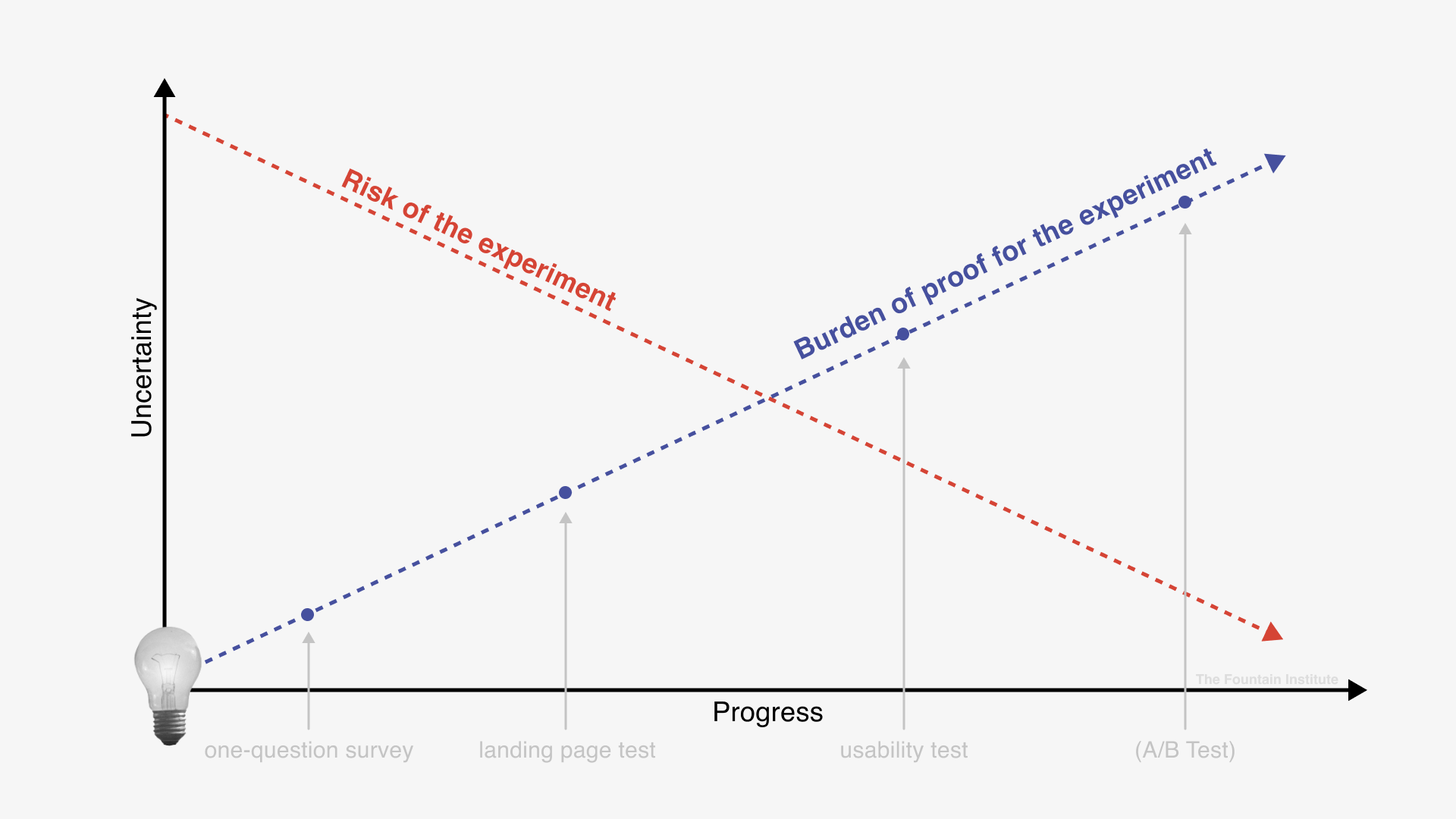
As you test the four innovation risks, you are de-risking your idea. And the more you test, the less risky your idea becomes. There’s a unique relationship between risk and complication of the test setup that’s worth mentioning because it feels counterintuitive at first:
[from my Guide to Testing & Experimentation on the Fountain Institute Blog]
As you work towards the innovation idea’s release, the burden of proof gets harder and harder. A quick survey of your users might de-risk some of the desirability early on, but you will need an A/B test to de-risk when you’re close to launch.
That’s because when you’re early in the innovation process, any data can provide an early signal and give you the broad-strokes kind of insight to knock out some of the more considerable risks. This is excellent news for those used to the sample sizes required for optimization work. Innovation work is all about generating as much as possible to de-risk the idea, even if that data isn’t perfect.
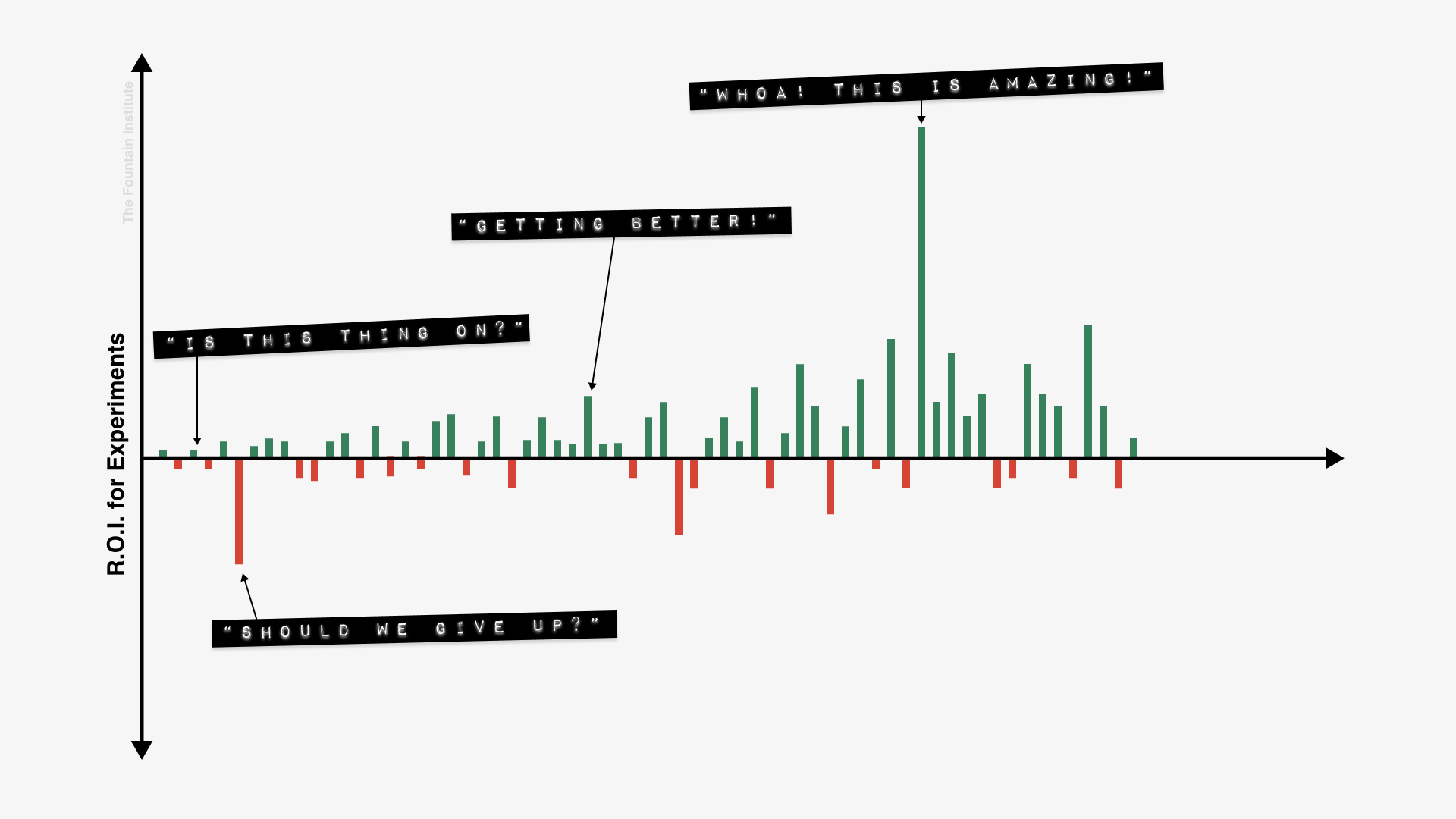
The good news is that the riskiness of testing also has its rewards. Here is a hypothetical year of testing:
[from my Guide to Testing & Experimentation on the Fountain Institute Blog]
When you first start testing, you will undoubtedly have some issues with your tooling. You may have more failed experiments than usual, but eventually, something great will happen. One day, you will discover something that will increase your numbers like you never dreamed.
That’s the power of experimentation: even failed results are an excellent learning opportunity!
I hope that seeing the different ways to de-risk ideas has shown you what the work of innovation looks like.
This article only scratches the surface. There are a million more ways to test for viability, feasibility, desirability, and usability.
If done well, you can turn big, risky ideas into market-changing reality.
Let Jeff de-risk your next innovation project
We all get busy and neglect to test for one of these four risks. But a little de-risking early can save you a world of hurt later.
If you have a little extra budget, hire me to run some tests before you go live. It will help you sleep better at night, and we might even discover an entirely new way to build your idea.
Book a consultation call, and let’s discuss!